

Burnished gold
Colin Smale pays tribute to the colourful Common Pheasant as the shooting season begins.
Driving through the Lincolnshire countryside or watching the fields and hedgerows slide past from a train window, one might pause to consider which bird is truly our most common. Robins and blackbirds are usually the first to spring to mind, yet one of the birds most frequently encountered – the richly coloured pheasant – is so familiar that it is often overlooked.
The Common Pheasant is widespread across Lincolnshire, and the reason is plain enough. Open farmland, woodland margins and thick hedgerows provide the ideal blend of cover and feeding opportunities that this species favours. Its presence is also closely bound to human activity.
As a long established game bird, pheasants are released in large numbers each year by farmers and gamekeepers in preparation for the shooting season, which runs from 1st October to 1st February. This annual practice has ensured that the pheasant remains a conspicuous feature of our rural landscape.
Original habitat
Despite its apparent ubiquity, the pheasant is not native to Britain. Its natural range lies in temperate Asia, stretching from the Black Sea and Caucasus through Mongolia and into China.
Introduced centuries ago by the Romans, we are told, it has adapted remarkably well to lowland counties such as Lincolnshire, where the landscape closely resembles that of its original habitat.
Elsewhere, the picture is very different. In upland and Highland regions – particularly in the far north and west of Scotland – pheasant numbers are extremely low.
These areas are less suited to intensive game management, and releases have historically been limited. As a result, the bird’s distribution across Britain is uneven, shaped as much by land use as by natural preference.
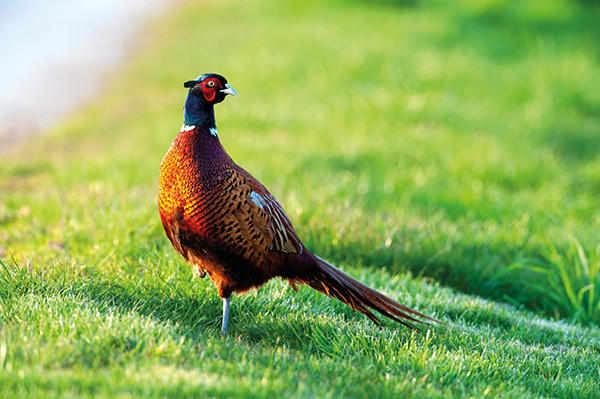
Every so often, a pheasant will wander unexpectedly into a garden, bringing a sudden flash of colour among lawns and borders. In such moments, it is hard not to admire its burnished copper plumage, crisp white neck ring and vivid red facial wattles.
Familiar though it may be, the pheasant remains one of Lincolnshire’s most striking birds – and one well worth more than a second glance.
We Recommend



Never miss a copy!
Big savings when you take out a subscription.
Problem displaying Facebook posts. Backup cache in use.
Click to show error