

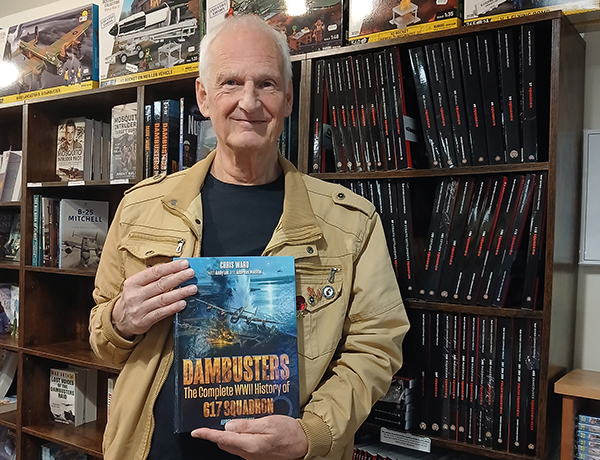
Paying tribute to aviation legends
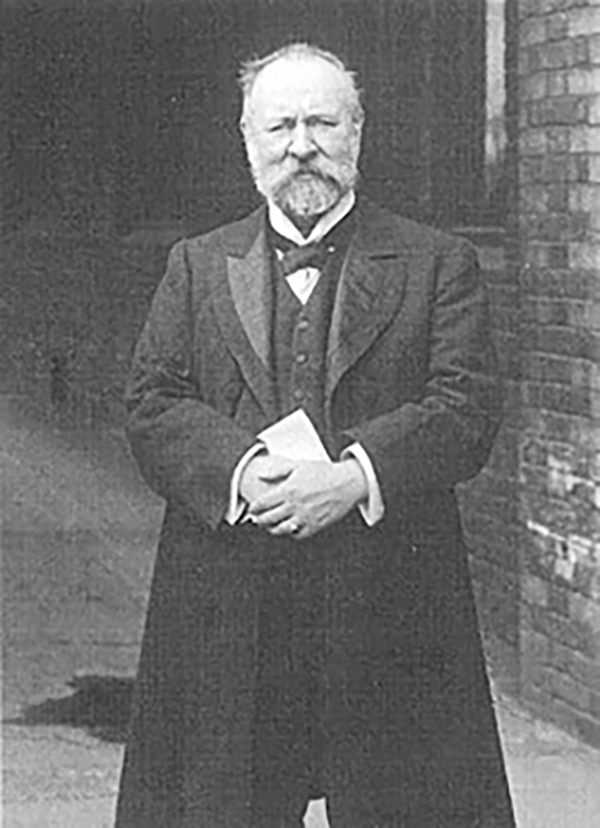
Historian Chris Ward has had a lifelong obsession with RAF Bomber Command and The Dambusters, as he tells Kate Chapman.
Chris Ward’s passion for The Dambusters – the nickname given to the RAF’s 617 Squadron after it carried out Operation Chastise, a daring raid to destroy three major dams in Germany’s Ruhr Valley, in May 1943 – began when he was a boy but has led him to original, first-hand research, walking crash sites on the continent and tracing Dambuster wrecks that lay previously undetected.
He has recently written his 57th book on the subject, but says there are still many more important stories to tell.
Chris’s latest book, which is part of a series called RAF Bomber Command Profiles published by Aviation Books Ltd, focuses on 214 (Federated Malay States) Squadron, which served as a standard bomber squadron until 1944, when it was tasked with jamming German night-fighter communications.
As well as writing historical books, Chris has formed a strong alliance with Lincolnshire Aviation Heritage Centre, at East Kirby.
He’s donated many records and artefacts for display and leads guided tours there.
“My writing gives me a purpose to get up in the morning,” says Chris, who has lived in Skegness since 2017.
“When you have a passion, it takes you in different directions and makes you want to do things – I’m a bit like a bloodhound!
Despite being the most prolific author in the world on RAF Bomber Command in World War II, outside of a very narrow interest group, I’m unknown. I’ve actually walked the Dambuster sites that I’ve described to my readers, which is what makes my books different from everybody else’s.”
Hooked on history
Chris’s obsession with RAF Bomber Command – the British military unit responsible for conducting the strategic bombing campaign against Germany and occupied Europe during World War II – started during his childhood. He says there was still a lot of talk about the war in the 1950s, but adds that the era was also a golden age for British aviation.
Chris grew up near Leamington Spa, in Warwickshire, where his father was a village policeman. As a boy he was fascinated by Bitteswell Aerodrome, which they often passed on their way to visit relatives in Lutterworth.
“It was an experimental site,” he recalls. “They had all these weird and wonderful new jet aircraft, which were of great interest to me.”
One of his aunts was a parlour maid at Chartwell, the Kent country seat of Winston Churchill, and married Sam Howes, an auto engineer who was his chauffeur between 1928 and 1936.
Chris stayed with the couple as a youngster during the 1950s, when his uncle took him to visit his post-war workplace at Bristol Aviation, in Filton, which further fuelled his interest.
“In 1955, when I was seven, my aunt took me to see The Dam Busters movie at the cinema, although I didn’t understand everything, I was hooked,” he adds.
“At the age of 12, I read Paul Brickhill’s book The Dam Busters for the first time – it’s wonderful.
“It reads like a novel, and it fascinated me. I’d read it from cover to cover, then go back and start again. That was my introduction, first to the Dambusters and then much later, that developed into a passion for Bomber Command.”
Research and writing
Chris has had a variety of jobs over the years, working in the civil service and as a lighthouse keeper. He owned a cleaning company and up until his retirement in 2016 was a warehouse operative for educational publisher Pearson Education.
He’s always enjoyed writing and began publishing his own spiral-bound squadron profiles during the 1990s, which he says proved to be very popular.
“I had a large library of books and was frustrated that I had to keep going to all these different books to get the information I wanted – there wasn’t anything definitive,” he recalls.
“I decided I’d write a definitive work on Bomber Command and put everything in.”
In 2000, Chris joined forces with a contact he met on a trip to the German dams to produce Dambusters: The Definitive History of 617 Squadron RAF at War 1943-1945, which was published by Red Kite in 2003. It was later expanded and also published as Dambusters: The Complete WWII History of 617 Squadron.
The book was catalogued by the Imperial War Museum archive as a work of national interest.
“Through my best friend Andreas Wachtel, a Bomber Command author and historian in his own right, I was able to meet German and Dutch historians, meet the local farmers and eyewitnesses and produce a book which was far more detailed than anyone had written before,” says Chris.
“We actually found some of the crash sites from the Dambuster aircraft that nobody had traced before.
“Andreas teamed up with a top aviation archaeologist to go off wherever I sent them, discover the crash site, survey it, dig up parts, talk to local people, eyewitnesses or historians, and then I would go over a few months later and we would revisit these sites.
“I was actually walking the sites that I was describing to my readers, which is what makes my books different from everybody else’s.”
Chris has periodically updated this book, last doing so in 2023, adding new research and findings when warranted. Over the years he’s self-published his work and been published by Red Kite, Pen & Sword and most recently Aviation Books Ltd (formerly Mention the War Publications), which specialises in military aviation, for which he’s written 41 titles.
Since moving to Lincolnshire, which Chris hails as his “spiritual county” he’s been working with Lincolnshire Aviation Heritage Centre, where a new National 617 Squadron Exhibition Centre is opening next year.
Chris says he loves giving tours and does everything he can to make it a special day for visitors.
“I tell them, ‘it’s your day. You tell me what you want to know, what you want to see, and ask me your questions, because I will be devastated if you go home disappointed’,” he adds.
“People love to be able to go to somewhere like East Kirkby, where they have their own Lancaster and Mosquito that taxi. They’ve got various other aircraft that they’re renovating, and it’s just an opportunity to put yourself into the 1940s and walk the ground that heroes walked on.
“There were two Lancaster squadrons flying out of East Kirkby from August 1943 to the end of the war, and many of the people who took off from there never came back, so it’s hallowed ground to me, and I think a lot of other people feel that as well.”
Chris Ward’s books are available from Lincolnshire Aviation Heritage Centre, Amazon and aviationbooks.org
Visit www.lincsaviation.co.uk/events for information on his tours
We Recommend


Never miss a copy!
Big savings when you take out a subscription.
The perfect gift for Christmas!Lincolnshire Life is packed each month with features on culture, history, local business and events, as well as spotlighting homes and gardens, fashion and ideas for how to make the most of life in Lincolnshire. Purchase a subscription at www.lincolnshirelife.co.uk/product-category/subscriptions today for £36 (or £18 for 6 months). Our magazine also makes a perfect gift, with a special card sent for you to pass on to the recipient with your own personal message. Subscriptions are priced from £36. You can order online at www.lincolnshirelife.co.uk/product-category/subscriptions or call 01522 689671.