

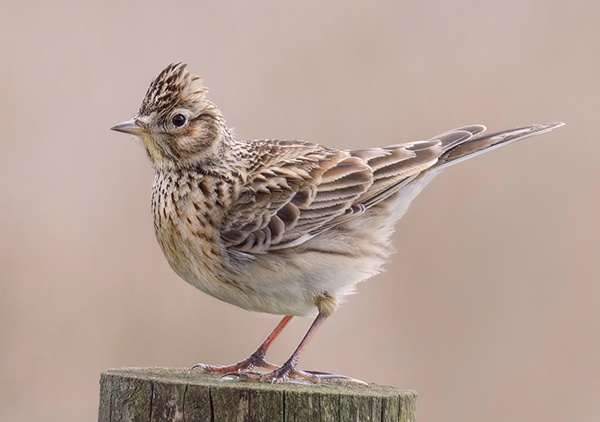
Skylarks on song
Bill Meek charts the trend of this much-loved songbird, often found soaring around the skies of Lincolnshire.
On a sunny day, the song of the skylark, with its unbroken cascade of glittering trills falling from the sky, is the very epitome of the Lincolnshire springtime; some might say an essential component of the farmed landscape itself.
Skylarks need no song perch, rising almost vertically into the sky as they sing until almost invisible, their song seeming to drift in waves, in and out of conscious thought.
The skylark’s song is celebrated with innumerable references in the arts. Chaucer, William Blake, Coleridge, Wordsworth, Elizabeth Barrett Browning, Shelley and Ted Hughes all wrote about the skylark and its song.
Most famously perhaps, it inspired Ralph Vaughan Williams’s orchestral piece ‘The Lark Ascending’, a now essential, almost definitive, part of the English pastoral tradition.
That piece was itself inspired by a poem of the same name by George Meredith, in which Meredith described the skylark’s song as a ‘silver chain of sound’.
Open skies
Skylarks are birds of open places. You will never see a skylark in, or even under, a tree, and even on farmland they tend to avoid anything ‘sticking up’ like hedgerows. This means that they were probably unknown in Britain until Bronze- and early Iron Age people cleared the wildwood and created grasslands for them to colonise, but since then they have been ever-present wherever man has worked the land.
The relatively open, predominantly agricultural landscape of Lincolnshire should make our county a natural stronghold for skylarks, and indeed they are common here.
Like many birds of farmland, however, skylarks have suffered a huge decline in numbers since the end of World War II, due to ‘cleaner’ crops, the switch from spring to winter cropping and the loss of weedy stubbles and untended, insect-rich corners.
While numbers in Lincolnshire nowadays tend to fluctuate, and farmers have been able to take advantage of agri-environment schemes designed to help the whole suite of farmland birds, sadly the long-term trend for the skylark here is still resolutely downwards.
Natural habitat
In winter, skylarks tend to congregate wherever there is food, but again, always in open situations. Some move to the coast, and Lincolnshire’s estuarine saltmarshes generally hold skylarks in winter. But skylarks also remain a component of the ‘little brown’ bird fauna of ordinary farmland throughout the year.
Outside the breeding season they may be given away by their harsh chirruping calls, white outer tail feathers and white trailing edges to the wings when flushed, or during the little quarrels and chases which anticipate pairing at the end of winter.
Precarious position
In an attempt to impart a flavour of home for emigrants, skylarks were exported for release into the wild wherever English people tended to settle.
They are now an established part of the bird fauna of Australia and New Zealand, but in the Americas attempts to introduce them have almost universally failed.
The skylark now hangs on very precariously at a single location in the south of Vancouver Island, where its song is something of a wildlife tourist attraction.
We Recommend



Never miss a copy!
Big savings when you take out a subscription.
Problem displaying Facebook posts. Backup cache in use.
Click to show error