

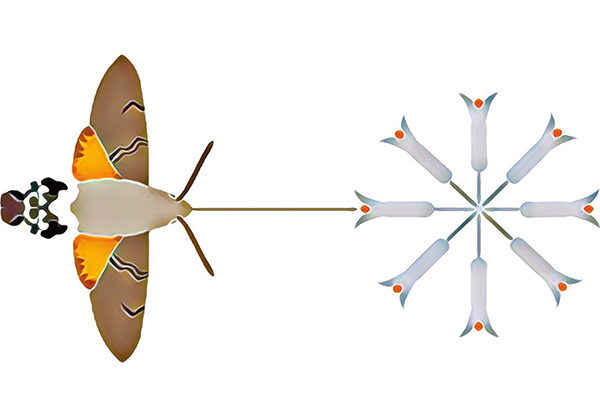
Hummingbird Hawk-moths take flight
Bill Meek looks at the everyday life of this striking moth, frequently found feeding in our gardens during the summer months.
At least once or twice every summer, anyone living in Lincolnshire with the right kind of flowers in their garden should be visited by a beautiful flying creature looking a little like a hummingbird, energetically feeding in the sunshine.
Despite the similarity, these cannot of course be hummingbirds, which are an exclusively New World family of birds. What people are actually seeing is the charismatic, and day-flying, Hummingbird Hawk-moth.
With a wingspan of slightly more than two inches, a Hummingbird Hawk-moth may be seen darting from flower to flower on sunny days, hovering and probing for nectar with its long, uncoiled proboscis.
The greyish-brown wings move so fast that they appear as a blur, and make an audible humming or throbbing sound when heard close up. The moth’s stout, white-spotted body and distinctive orange underwings are enough to identify it immediately.
They are strongly attracted to flowers with long corolla tubes holding plenty of nectar, such as honeysuckle, buddleia, escallonia, phlox, lavender, petunia, nicotiana, red valerian and fuchsia, or in the wild, Viper’s Bugloss.
They have the remarkable ability to never visit the same flower twice, although the cues needed to make this behavior possible are still unknown.
Lifecycle and seasons
Hummingbird Hawk-moths are recorded in Britain every year, but in wildly fluctuating numbers. They are very common residents across southern Europe and central Asia, and migrate northwards during the warmer summer months, breeding as they go. Strong or prolonged southerly winds make an invasion of our shores more likely, and hot summers encourage them to breed.
The caterpillar, up to 6cm long, can be either green or brown, always with white and yellow stripes and a prominent and colourful horn at the rear end. They can be found fairly regularly in the UK, feeding on various bedstraws or madder. Locally-bred moths are probably the reason for the late-summer peak in sightings.
Watch out for Hummingbird Hawk-moths in your garden any time up until the onset of bad weather in the autumn, when the adult moths will either die off, or undergo a limited reverse migration.
Hummingbird Hawk-moths have great difficulty surviving our winters, which means that the continued presence of this moth in Britain is dependent upon annual recolonisation from the south.
Occasionally an adult will try to hibernate in Britain, and if they find a warm enough spot they may survive for a while, and sometimes one may be disturbed from its resting place in winter.
Over-tidiness in the countryside is the enemy of the Hummingbird Hawk-moth, as well as much other wildlife.
The phenomenal numbers seen in the summer of 1946 were said to be a result of the relaxation of cutting of waysides and meadows during World War II. More recently, both 2003 and 2006 were “big” years for these moths, although both were dwarfed by the invasion of 2022, which was widely speculated to be a portent of climate change.
We Recommend



Never miss a copy!
Big savings when you take out a subscription.
Problem displaying Facebook posts. Backup cache in use.
Click to show error