

Lincolnshire landscapes under threat
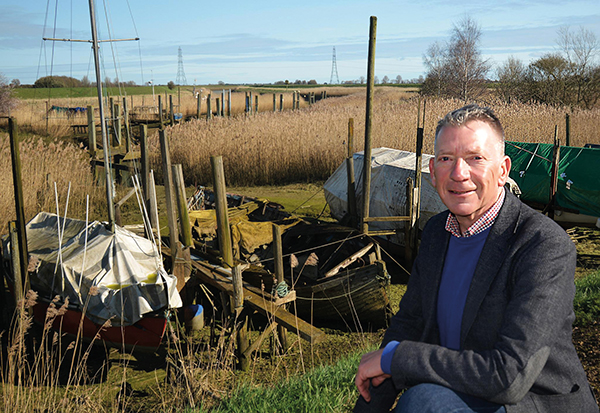
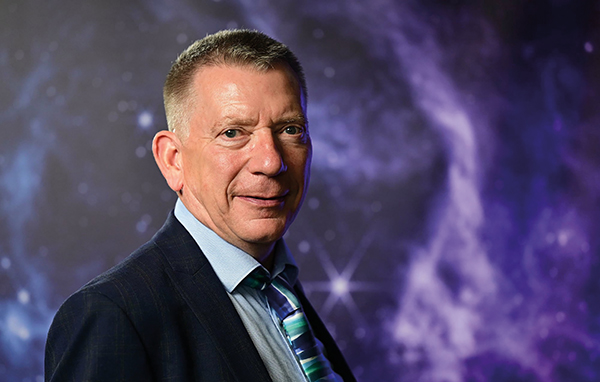
Kate Chapman speaks with journalist Clive Simpson, who explores the rising risk and effects of climate change in his recently published debut novel.
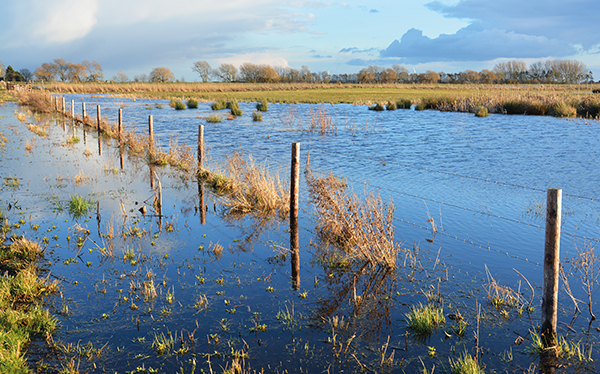
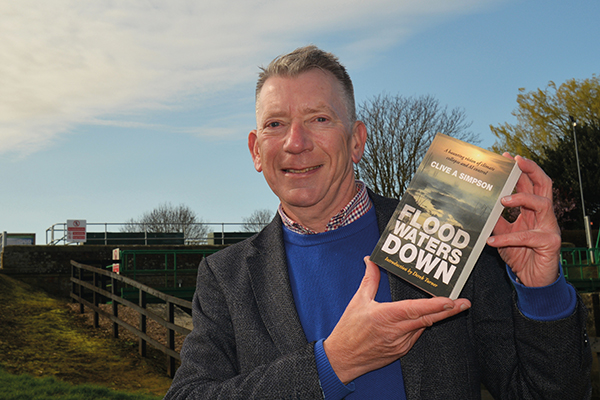
How might Lincolnshire look if the sea waters carry on rising and climate pressures continue to intensify? These are the questions journalist Clive Simpson explores in his debut novel Flood Waters Down.
Clive describes the book as a near-future dystopian eco-thriller, set in the drowned fenlands of south Lincolnshire. Drawing on real places across the area, it is inspired in part by the east coast storm surge of 2013.
“If you’re going to write about climate change, it helps to set it somewhere real – somewhere people recognise and care about,” explains Clive, who grew up in Spalding and now lives near Sleaford.
“The Fens have always been a landscape shaped by water. In the novel I simply ask: what happens if the water finally wins? What might this landscape look like in the middle of this century if sea levels continue to rise and climate pressures intensify?”
The book, published this spring by Cliftop Publishing, explores several contemporary themes including climate change and the rising seas, the return of the fens, social fragmentation and artificial intelligence and control.
Clive says in this altered landscape, large areas of eastern England have been surrendered to the returning waters as the effects of climate change intensify.
Communities cling to higher ground while a loose network of renegades, survivors and traders navigate flooded waterways that once carried roads and railways. Meanwhile, behind fortified walls and advanced technology, the wealthy attempt to insulate themselves from the growing chaos beyond.
Local inspiration
The story moves between the flooded Fens, the decaying remains of London, and an elite settlement known as Tulip Haven – a supposedly secure refuge for the ultra-wealthy that is increasingly governed by an autonomous AI.
Clive says it was a visit to Surfleet Seas End, near Spalding, where the River Glen meets the tidal Welland, following the storm surge of December 2013, which sparked the idea for Flood Waters Down.
“I went down there to meet some of the farmers, and people living in the area. Standing on the lock gate it suddenly struck me how small the margin is between land and water in this part of the world,” he explains.
“On the first anniversary, the farmers had put up a small plaque to where the water had come to, and that was the inspiration. Having grown up in Lincolnshire, you get used to the big skies and the drains. I always thought that if I did write a novel it would have to be set in an environment that I knew or had lived in.
“For as long as I can remember I’ve been interested in the environment and the possibilities of climate change, so I’ve put the two ideas together.”
He adds that many real locations across the Fens influenced the fictional world of the novel, including areas around Fosdyke Bridge, Surfleet Seas End, Spalding power station and the Sir Peter Scott Lighthouse at Sutton Bridge.
Career steps
As well as the environment, Clive has always been fascinated by words and the written language. After attending Spalding Grammar School, he trained as a journalist with EMAP and began his writing career working at the Lincolnshire Free Press and Spalding Guardian.
“At school, I was always writing, doing different things, journalism didn’t materialise as a possible career until I was in the sixth form. It sounds a bit corny, but I watched the Watergate film All The President’s Men at the cinema and that’s when I decided what I wanted to do,” he recalls “I left school and joined EMAP, it was a really good grounding working on a bi-weekly paper.”
Clive also worked in Peterborough and Lincoln and on the Portsmouth Evening News before specialising in space technology and science, which has always been one of his interests.
During his 40-year career he has written for a range of organisations including the European Space Agency (ESA), BBC and many international publications. He has edited London-based Spaceflight magazine and since 2015 served as editor-in-chief of ROOM Space Journal.
He writes a topical blog, So Said the Lighthouse Keeper, featuring commentary on space, climate, politics and culture and in 1997 he founded and ran SimComm Europe, an award-winning media agency with offices in Portsmouth and Almancil, Portugal.
Passion for writing
Clive says he is fortunate to have been able to combine his passions for writing and space technology and adds that his career has taken him all over the world.
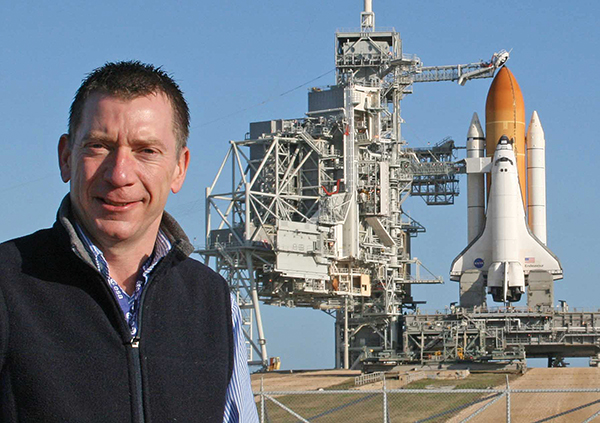
“Highlights have included visiting the launchpad used by cosmonaut Yuri Gagarin in Kazakhstan and reporting from the Kennedy Space Center on space shuttle missions a few times,” he adds. “Working as a freelance reporter, covering space and space business, I’ve been very lucky doing something that I love, it’s a dream job for me.”
Clive admits that working on his novel has been quite a juggle alongside his regular writing work, but he says treating it as a job rather than a hobby was the key to getting it finished. “Writing a book has been completely different, but something I’d wanted to try for a while,” he says.
“Everything I’ve written for years has been factual, so I’ve had to learn to write in a different way, but it’s been good trying something different.
“I’ve learnt a lot about publishing in the past year and it’s something I hope to do more of.
“Without giving too much away, Flood Waters Down ends with a bit of ambiguity. I’ve left it open for a follow-up, there are a few loose threads and a couple of characters whose stories aren’t quite finished. I’ve already been working on a few ideas.”
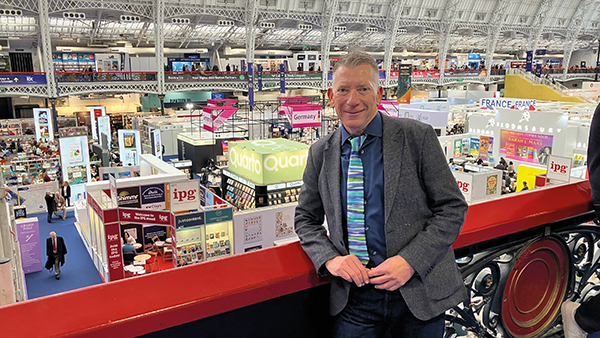
Clive plans to visit some of the county’s bookshops this summer to take part in book signings and also hopes to make a few appearances at book festivals across the region too.
“Although Flood Waters Down is set in the near future, it’s not about predicting the future, more about asking about what might happen if the trends we are seeing continue, that’s the crux,” he adds.
“While it is all a bit dystopian, there is still hope.”
To find out more about Clive and his work visit www.clivesimpson.co.uk
Photographs: courtesy of Clive Simpson
We Recommend



Never miss a copy!
Big savings when you take out a subscription.
Problem displaying Facebook posts. Backup cache in use.
Click to show error