


And the band played on…
Dating back to Victorian times, bandstands were once found in many public parks throughout the county and today a few still remain. Dene Bebbington charts their history and heritage.
Have you ever wondered what our Victorian ancestors did for leisure before the advent of radio and television, and why this question vexed their moralistic betters?
Lincolnshire is one of England’s biggest counties by area and, although wonderfully rural, does have a capital city and a few other urban areas. Lincoln is different to the smaller coastal towns of Skegness and Grimsby, but it has something in common with them about past recreation.
At one time Britain was dotted with hundreds of bandstands, mostly located in parks. Sadly, their heyday belongs to a bygone age, yet their story tells us a lot about how society has changed.
Designs and use
The origin of bandstands can be traced back to royal parks and pleasure gardens frequented by the upper classes. A two-storey pavilion with open sides, where orchestras played from the upper floor to entertain the well-to-do audience below, enhanced London’s 18th-century Vauxhall Gardens. This outdoor platform eventually inspired the form of a bandstand.
Britain’s very class-ridden 19th-century society led to moral concerns about how working people used their precious spare time and spawned the notion of ‘rational recreation’, in contrast to boozing, betting on cock-fights or other unseemly activities.
By 1833 the government took enough interest in the issue that a Select Committee on Public Walks considered ‘the best Means of securing Open Spaces in the Vicinity of populous Towns, as Public Walks and Places of Exercise, calculated to promote the Health and Comfort of the Inhabitants’. Public parks were seen as an answer, but it took until 1840 for the first urban park to open at Derby’s Arboretum.
The traditional bandstand design we’re familiar with dates to 1861. One made for the Royal Horticultural Society’s garden in London comprised a base reached by a few steps and ornate iron pillars holding up a dome. Open to the elements, structures like it were typically called bandhouses, rotundas or kiosks – the name bandstand had been coined around 1852 but took until the 1870s to enter common usage.
Even when working people’s needs had been taken into account and they were offered the chance to enjoy a park stroll, they had to put up with objections from a religious establishment wanting to limit their options, because for many Sunday was the only full day away from the grind. Bishops achieved a brief victory in 1856 when a temporary ban was imposed on Sunday concerts after their campaigning that ‘Recreation on the Sabbath was thoroughly unacceptable; it was widely regarded as one of the worst types of desecration.’
Lincolnshire locations
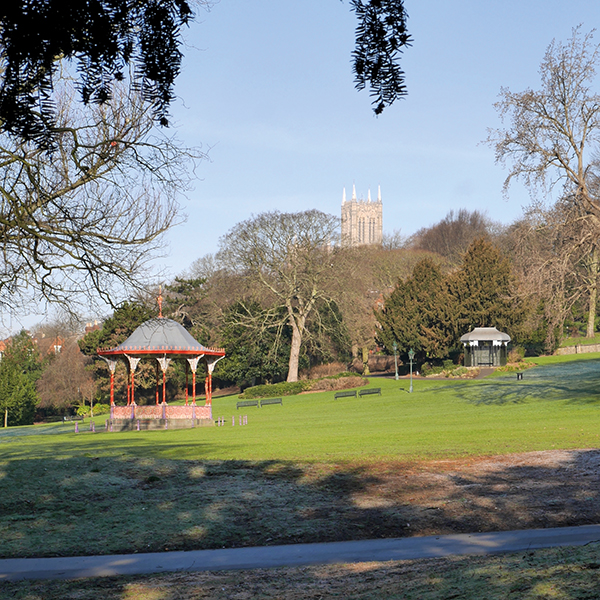
Unsurprisingly given its size, Lincoln boasts two bandstands. Keeping up with the national trend of creating public parks for the hoi polloi, the city’s arboretum opened following the Lincoln Commons Act of 1870 authorising purchase of Monks Leys Common.
Years passed until a bandstand finally featured in 1884 and that year, along with the name of mayor F. J. Clarke, is memorialised in the base.
Decoratively the arboretum bandstand is an especially fine example, in the whole of England and not just Lincolnshire. It’s made up of ornately detailed and colourful ironwork in the pillars, railings around the platform, around the cupola’s edge and the finial atop.
The arboretum didn’t avoid a decline plaguing many parks and bandstands through the 20th century, and the dilapidating bandstand gradually lost its charm. But that wasn’t the end of its story. In 2003 the arboretum re-opened following restoration work including repairs reverting the bandstand to its original condition.
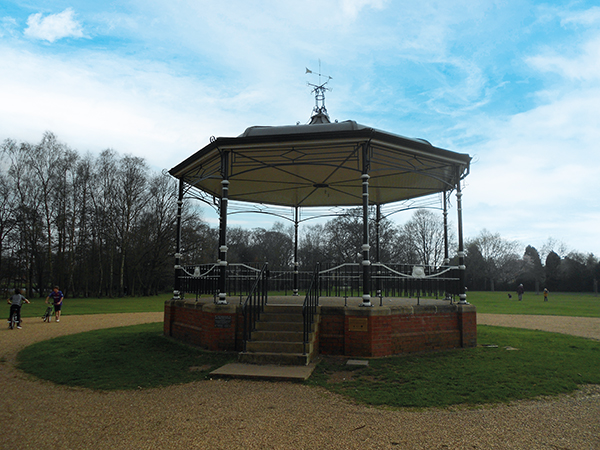
The city’s other bandstand is located at Boultham Park, which opened in 1929 after being bought by the council. Though the grounds were actually Boultham Hall’s park prior to that, a bandstand added decades after the Arboretum’s, in 1936, is less fancy in muted black and white ironwork, while a weather vane adds a little character.
It too reached a point of needing refurbishment, so in 2016 the base was resurfaced, the metalwork restored and the cupola covered in zinc.
Grimsby also sports two bandstands. The People’s Park bandstand was rebuilt in 1995 after the original timber one had been demolished a couple of years earlier. The ironwork is painted in a pleasing green and gold scheme and the cupola is a shallow pyramid shape. Luckily, it avoided serious damage in June 2025 when youths started a fire near to it.
Meanwhile, Alexandra Dock may be the only quayside in England hosting a bandstand since most are sited inland. The docks’ industrial fishing heyday is long gone, so the area transitioned to residential and retail use in modern times. At first glance a bandstand here seems incongruous, yet it fits in with the surrounding buildings by having an unassuming cupola covered in roof tiles.
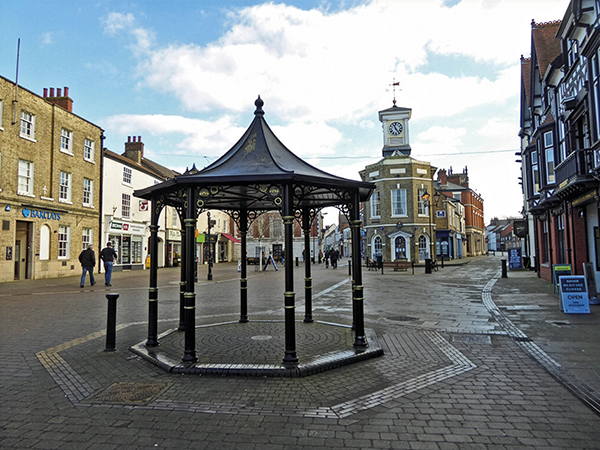
Brigg’s marketplace is another unexpected site for a bandstand. This small, low-key affair painted in black and gold lacks a raised platform and isn’t big enough to fit a brass band or orchestra. Charity or not-for-profit groups (no buskers!) can play there when approved by the town clerk.
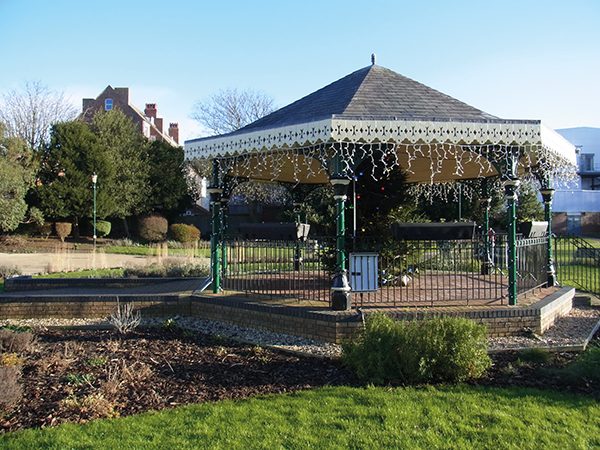
Every year Victorian-era attractions alongside modern amusements lure tourists to Skegness, the county’s premier coastal resort. Tower Gardens, named Pleasure Gardens until 1898, is situated not far from the beach and is home to a bandstand unusually having two wide entryways at opposite ends of the octagonal structure.
Its long-awaited replacement dates to the turn of the millennium and its predecessor was dismantled before World War II. It has been given at least one change of colour scheme as the ironwork, once red and black, is now green and black.
During Christmastime, Skegness’ bandstand gets a slight makeover, being adorned with fairy lights and containing a Christmas tree.
In 2025, it served as the 80th anniversary VE Day celebration focal point, where a singer dressed in wartime uniform entertained the audience with renditions of stirring songs such as ‘We’ll Meet Again’.
A few activities and aspects of our heritage remain timeless and appeal to new generations. While too many bandstands are lost and forgotten, surviving examples keep the past alive and remind us that simple pleasures still have a place in this busy world.
Credit: Richard Humphrey
We Recommend





Never miss a copy!
Big savings when you take out a subscription.
Problem displaying Facebook posts. Backup cache in use.
Click to show error