

A Poet in the Vale
Steffie Shields ponders a historic garden and romantic poet John Clare’s visit to Holywell.
A fascination for exploring gardens stems from curiosity. The detective in me loves to solve the mystery of a garden’s essence, when and why it came to be made, its evolution, and who was responsible.
How has it escaped decline, and that unfortunate combination of family circumstance, human neglect and nature running riot?
Location is key. Topography is often the underlying stimulus for either garden owner or commissioned designer to respond in creative and practical ways.Consider every view and aspect of the compass, and whether they have been cherished and added to over generations.
“Walking the ground” is imperative to assess the story of a landscape garden, what one celebrated 18th-century improver, Lancelot Brown, chose to call its “capabilities”.
Observe the approach drive, and chosen positions of every major man-made ornament, including water features, and those mature specimen trees planted by design.
Whether negotiating formal straight walks or winding paths, sense both changes in levels and surfaces, from gravel or sand walk, from paved stone terrace to soft turf.
Where possible, question owners and their gardeners. Then the fun starts, digging for clues in archives, libraries and online, to discover layers of noteworthy garden history.
Exploring Holywell Hall
Last spring, Cambridgeshire Gardens Trust invited me to join their members on a visit to Holywell Hall, for centuries until the 1950s the home of the Reynardson family.
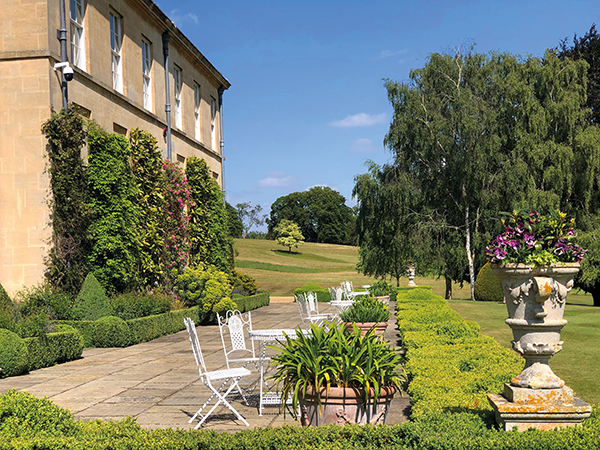
I was asked to give an introductory talk about its 12-acre, 18th-century landscape gardens. We gathered on the Hall’s south terrace, edged by contemporary designer Bunny Guinness’s lacy box hedging basking in May sunshine, a good vantage point for all to take in the breathtaking panorama.
The immaculately mown, chequered lawn swept down to the ancient little church on the eastern edge. The Gothic doorway of St Wilfrid’s, with its William and Mary turret, was adorned with white climbing roses and attendant box shrub roundels.
A few steps away, a veteran occidental plane tree shaded a dappled silhouette, the “holy” well of legend. Unsubstantiated stories tell of a religious community living in this vale in olden times, where spring waters were once said to heal the blind.
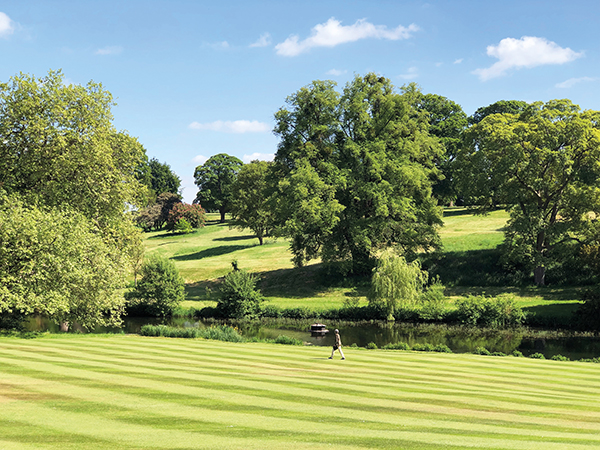
Beyond, the lake reflected lush park trees and pasture, its river-like waters extending towards the Fishing Temple southwest, backed by woodland.
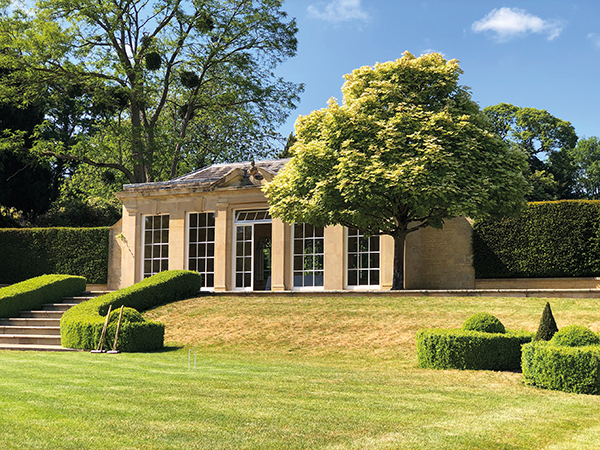
Samuel Reynardson, circa 1732, built this for his new bride, with Tuscan Doric portico in London-Palladian style, as also the equally classic Orangery, further northwest.
Hesitating, should I break the spell, that shared experience, a communal, quiet “pause to ponder” beauty?
The son of a Nottingham lace-maker came to my aid. In 1864 Reverend John Wild (1826-1902) became officiating curate at St James’ Church, nearby in Castle Bytham. Over one-and-a-half centuries ago, he summed up Holywell’s apparently unchanging, hidden valley: “We find rare spots on earth where art and nature strive in sweet accord to charm the eye and captivate the soul… Woodland and water, grassy slopes and winding valleys offered capabilities which culture, guided by exquisite taste, has wrought in exceeding loveliness.” (J. Wild History of Castle Bytham, Chapter XII, p. 117).
My first impressions of this Brownian landscape garden came in 1999, with two further visits since.
Although Brown worked locally at both Grimsthorpe and Burghley, I could find no evidence of his hand. It has come to light that, in the 1760s, a similar polymath, Thomas Wright (1711-1786) assisted Samuel Reynardson with improvements, perhaps influenced by the Royal Gardener’s lake-making and “natural” tree-planting.
Digging into history
In 2018, Historic England chose to add to Holywell Hall’s Grade II* listed status to protect its considerable heritage, listing its setting as a Grade II Historic Park and Garden.
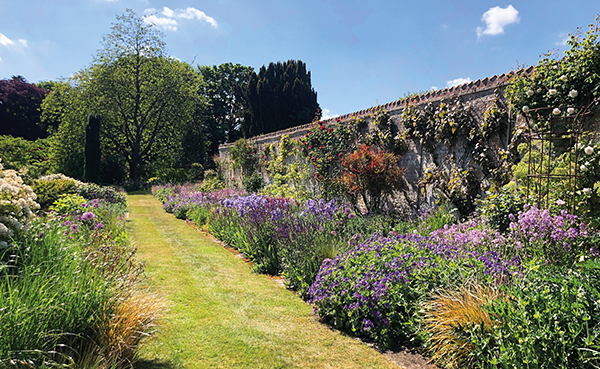
Details of Holywell’s history and its national significance are found online at www.historicengland.org.uk where a drone-assisted aerial photograph shows the scale and layout of the site, and its updated herbaceous borders, stone-walled gardens and grounds maintained to manicured perfection.
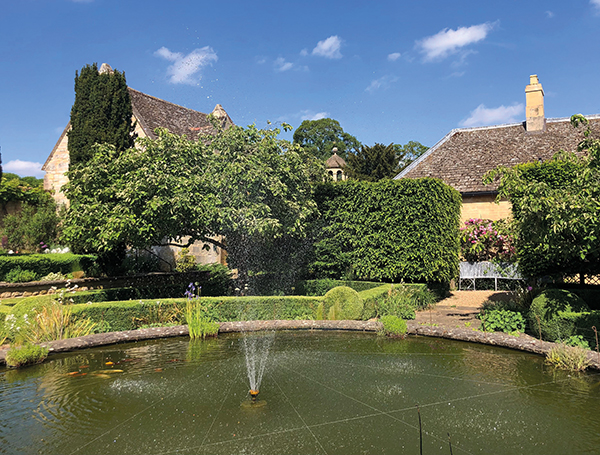
In the 1990s, Bunny Guinness introduced assured perennial planting, both in the sunken pond garden, and in richly floriferous borders that, together with a profusion of climbing roses, screen south-facing, sloping kitchen gardens, also given a make-over.
Stepping through the wrought-iron gate, high clipped yew hedges, either side of a central cascade, frame a smart glasshouse on the north wall. Water tumbles down the rill’s shallow steps, with textured planting either side, into a sparkling fountain below.
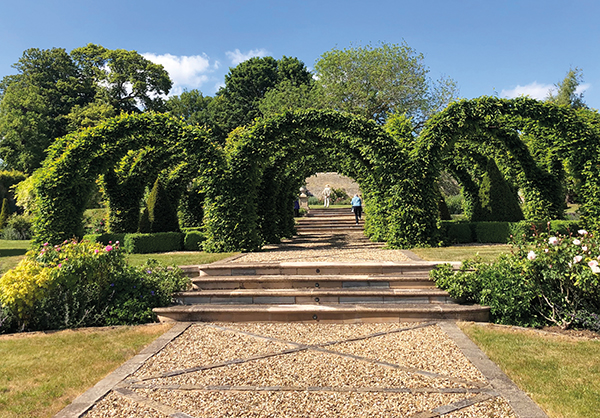
A productive herb and vegetable parterre occupies the east section. In the west, Bunny designed a series of low terraces divided by a central gravel walk with pristine stone steps leading up the rise.
Wavy flowerbeds of roses and lavender offer foreground interest, while four wisteria trees trailing white blossoms over wrought iron supports, accompany the most inspired feature I have ever laid eyes on, an Arcadian “must-see” surprise for every visitor.
Her unique pergola, constructed by Manor Welding of Grantham, consists of pleached hornbeam trees, Carpinus betulus, trained across three rows of metalwork arches. Beautifully clothed in May by abundant emerald-green foliage, it offers welcome shade come high summer, and an equally striking display come autumn, a living cloister that successfully introduces height and innovative structure.
Let’s venture back to the 1840s, when one warm April day, the romantic poet John Clare (1793-1864) strolled eight miles from Burghley’s walled garden, his workplace outside Stamford, destination Holywell.
“Inspired by brushing hill and dell”, he immortalised the magical spot in a long poem. His “song to nature” celebrates the delights of wandering the rustic countryside, seemingly without a care. Yet he remembers a troubled boyhood made bearable by childish delights, picking daisies and pulling up primrose roots.
Sadly, Clare suffered ill health and a troubled life, eventually ending his days in an asylum, only made better by his continuing to write poetry.
A gifted poet has considerable advantage. More powerful than an artist’s impression or photographer’s eye, a bard’s recall, mulling over a pastoral paradise, has the ability to summon arresting, often economical vocabulary to convey an unexpected impact made by enchanting ‘sense of place’ on onlookers’ emotions and minds.
A “new” entrance approach into the park from the southeast, shown on an undated 18th-century map, gave visitors a memorable first glimpse of that tranquil view down to the “river” and up to the elegant hall on the hill. Though no longer in use, this was perhaps a so-called “Heaven’s Gate” enhancement popular at that time. Imagine, towards dusk, John Clare slipping through the gates to catch a calming glimpse of water between park trees, then pausing to contemplate a trinity of garden ornaments: Fishing Temple, Orangery and rustic chapel.
Here are a few, select lines from his ‘Holywell’, where his sensitivity encapsulated a rare heavenly moment:
…With joys as sweet as heart could melt,
With feelings dear as e’er were felt,
I met at last, as like a spell,
The ‘witching views of Holywell;
Where hills tower’d high their crowns with pride,
And vales dropp’d headlong by their side,
Bestriped with shades of green and gray,
The fir-tree and the naked spray;
While, underneath their mingling grains,
The river silver’d down the plains,
And bolted on the stranger’s sight,
As stars blink out from clouds at night…
We Recommend




Never miss a copy!
Big savings when you take out a subscription.
Problem displaying Facebook posts. Backup cache in use.
Click to show error