


Super shrubs
Steffie Shields advocates hardy and robust star plants.
Let’s ‘beat about the bush’ this month! Although strictly speaking, this well-used idiom encourages us to ‘get to the point’.
This month is the optimum time for planting shrubs and, while wielding the spade, why not dig in a sprinkling of spring bulbs nearby. Don’t delay, especially if you have lost plants during this summer’s dreadful drought.
On the basis that most folks are time poor, my recommendations here require little care after planting. Rather than familiar hedging plants to enclose the perimeter, the emphasis will be on feature shrubs for focal points, to introduce a new look and lift the feel of your place.
Thinking caps on. Ask yourself a few quick questions before heading out to the garden centre or local nursery: what colour will look attractive? How tall a specimen do I need? Will its new home be part shade or full sunshine.
Once in shopping mode, avoid impulse buying, and take time to check label information. Here are some suggestions.
I have kept a garden diary to record plant purchases ever since moving to Welby. I found several useful specimens at a Millennium Plant Fair at Scrivelsby Court organised by Lincolnshire Gardens Trust. None more so than one delicate deciduous shrub, Deutzia gracilis, which cost £1. Twenty-six years later, this native of Japan, known as the ‘snow flower’, has required no effort since and zero maintenance, and came through recent, record-breaking high temperatures without seeing a watering can!
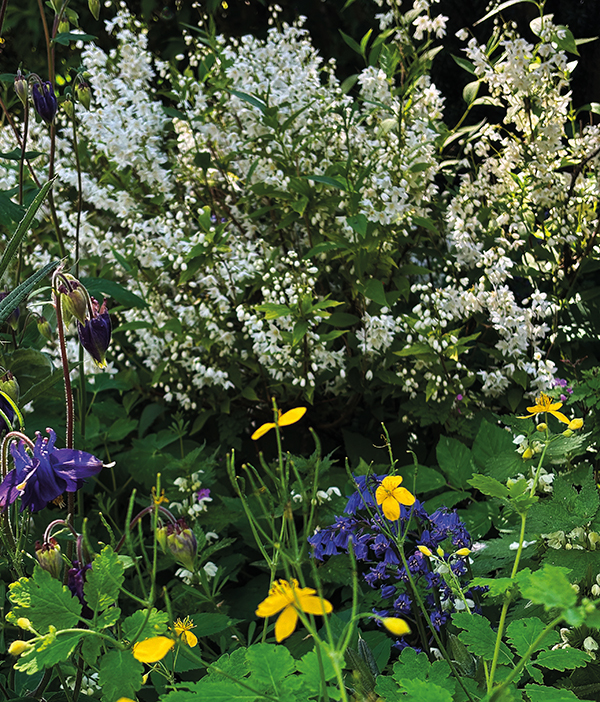
This delightful bushy shrub, roughly a metre high, and slightly wider, sports a cascade of fragrant star-shaped, white flowers along slender sprays.
Every spring through to early summer, my dear Deutzia blooms ‘its socks off’ for weeks, a splendid eye-catcher in a shady corner amongst aquilegia, bluebells and buttercup-yellow greater celandine.
At the other end of the spectrum, Cotinus coggygria ‘Golden Spirit’ is a large statement shrub which thrives in full sunlight. In 2008, not long after my mother died, I was attracted by both the hybrid name and the odd, almost circular foliage.
New leaves are at first bronze before morphing into a handsome shrub a gorgeous golden yellow situated in the foreground of a mature purple beech tree, a match made in heaven.
If its tiny, inconsequential blooms disappoint, their strange misty effect soon demonstrates how Cotinus came to be called the ‘smoke bush’. It requires only the occasional spring prune with clippers every few years to keep a pleasing form and to encourage its extraordinary late summer clouds of greenish flowers on soft hairy plumes.
Towards evening, like a powerful spotlight from the west, low sunbeams strafe across the lawn to set our smouldering bush on fire. Come autumn, golden hues continue to please the eye with burnished tints of apricot, coral and orange.
Another hybrid smoke bush, Cotinus ‘Grace’ provides a ‘Joseph’s coat’ of colours. Nonetheless, ‘Golden Spirit’, the most prominent ornament in our garden, means more as each year passes, especially on celebrating our golden wedding!
Butterfly bush
Most gardeners have a sunny spot for a large Buddleja, native to South America and China. Like many plants with silver grey foliage, it copes with most soils and extreme temperatures. First introduced to Europe from Chile, the famous Carl Linnaeus named Buddleja in 1753, after Adam Buddle (1662-1715) a Lincolnshire botanist and clergyman born at Deeping St James, who in 1708 completed a new ‘English Flora’. His 13 bound volumes contained almost 2,000 dried specimens from habitats across England.
Famously called ‘the butterfly bush’, Buddleja grows quickly, and needs both space and rigorous cutting back, almost to the ground each spring to encourage fresh growth.
Mid-July onwards, copious arching stems then bear long, slender panicles of tiny, sweetly scented, bluey-purple flowers that act as magnets for butterflies.
More nurseries are responding to the changing climate by growing more resilient plants. Last year I discovered a new Buddleja davidii hybrid.
‘Candy Little Purple’ grows a mere metre high. This compact miniature version has the same narrow, grey-green leaves and qualities as its ‘big brother’, providing a continuous show until autumn. Chubby cone-shaped clusters with miniscule rich purple flowers attract butterflies by the score with a delicious light scent, and are easy to dead-head in a trice.
By November, Viburnum x bodnantense loses most of its foliage and appears decidedly ‘twiggy’. Then, as the temperature plummets, nature likes to conjure a surprise that defies logic when all around is wintry. This tall, robust bush suddenly springs into flower to flout the chill. Its bare branches begin sporting close, budding bunches. Its tiny pink blossoms eventually fade to white, hanging on for months.
Perfect pergolas
Lastly, why not ponder a pergola? Last June, I visited Ludney House Farm, near Louth, a large garden which has opened these last 10 years for the NGS ‘yellow book’ charity.
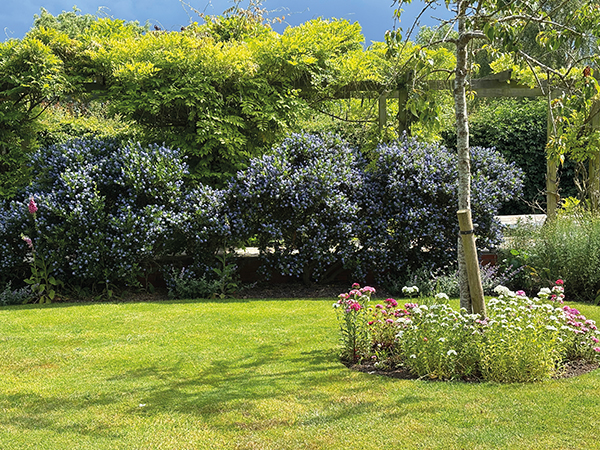
Jayne Bullas, its creative owner, has plenty of space to experiment. A long wood pergola was covered with lush, limey-green wisteria foliage. So far, so conventional.
What stopped me in my tracks, numbers of bushy shrubs sheltered the path, all one species, stretching the entire length. This brilliant blue wave of flowering Ceanothus almost matched the stormy blue sky beyond. I have never seen such a ‘cool’ combination.
This North American evergreen shrub, commonly called ‘Californian lilac’, has 60 species varying in colour and habit, nowadays including 300 hybrid cultivars.
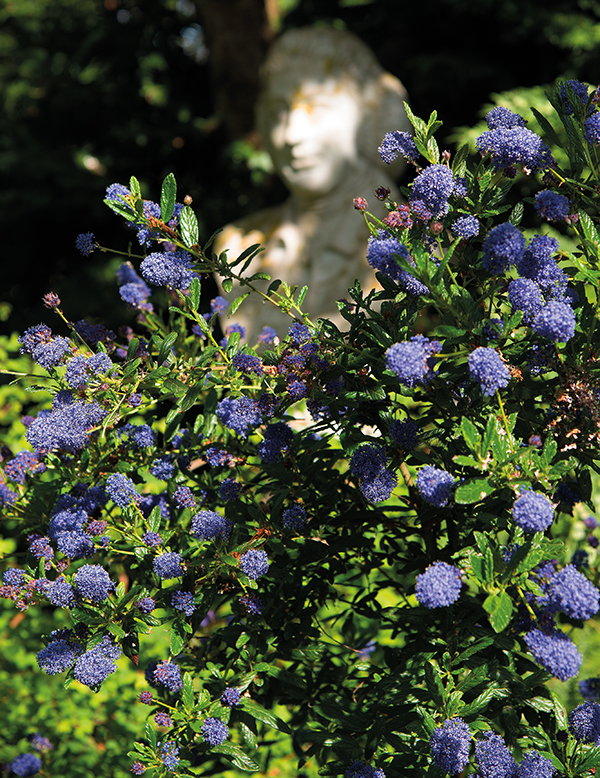
One specimen with an RHS Award of Garden Merit, Ceanothus ‘Concha’ has flourished beside our smiling ‘Capability’ Brown bust in semi-shade without watering despite this year’s torrid heat, its summer flowers humming with pollinators.
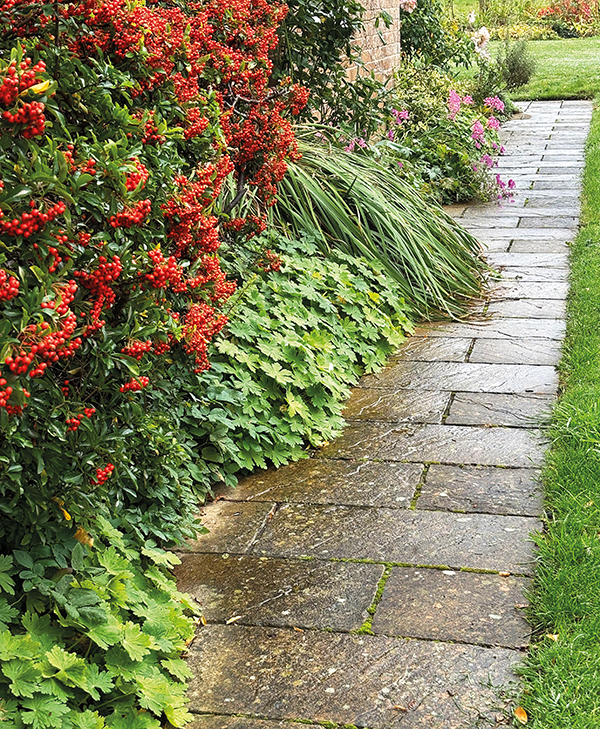
A thorny evergreen, Pyracantha (firethorn), is trained against our house wall along the path and under my study window. Its heart-warming, orange berries will soon ripen to shiny red. Mr and Mrs Blackbird will then come to feast unperturbed by my presence.
Whatever super shrub you choose, consider carefully its position: perhaps in the middle of a lawn – as a structural backbone for a border or the focal point of a vista.
Be sure to cosset your choice, digging in a generous dose of fertiliser as a warm welcome.
Look forward to benefitting wildlife in 2027 and remember these wise words, shared by the late, great TV guru, Geoff Hamilton: “The sun may not always shine in your garden, but I promise you, you will think it does”.
We Recommend






Never miss a copy!
Big savings when you take out a subscription.
Problem displaying Facebook posts. Backup cache in use.
Click to show error